
In this blog post, Yves Cattel examines what the Dutch Supreme Court’s “Belgian Holding” case and the ECJ’s “NEO” judgment tell us about the practical application of dividend withholding tax exemptions in cross-border holding structures. The emerging lesson is that substance remains important, but may no longer be sufficient on its own. Increasingly, courts appear to look at the degree of active involvement a holding company has in its subsidiary when assessing whether withholding tax relief should be available Let’s dive in…
Last summer (2026), the Supreme Court of the Netherlands issued a ruling that was expected to be a landmark decision on dividend withholding tax [Hoge Raad 18 juli 2025, 22/02695, BNB 2025/123]. The Supreme Court was a little bit cautious and therefore the judgment was a bit disappointing because it left some questions unanswered. Last month’s NEO Case from the European Court of Justice answered a pending questions and therefore its time for an update [CJEU, 15 October 2026, Case C-203/25, NEO Group].
One of the objectives of the European Union is to facilitate an internal free market. This means that as many trade barriers as possible must be removed so that investments in other Member States are treated the same as investments in the Member State itself.
As part of this objective, the European Commission is tasked with removing tax obstacles as much as possible. Through the EU Parent-Subsidiary Directive, dividends are prevented from being taxed twice. The Member State from which the dividend is paid may not levy dividend withholding tax at source, and the receiving Member State grants an exemption.
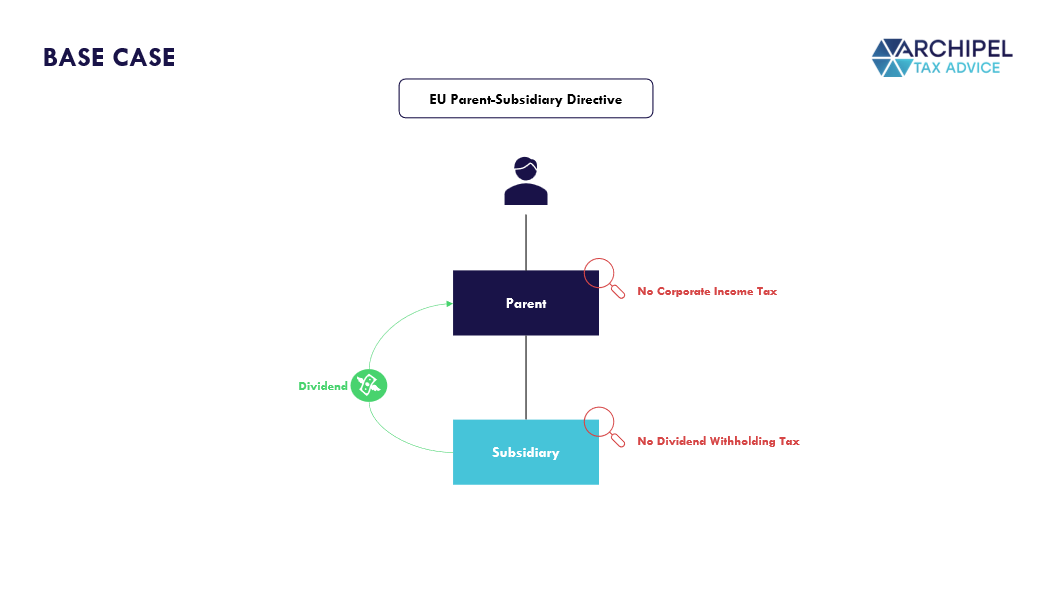
This Supreme Court ruling concerns the Dutch implementation of the Parent- Subsidiary Directive with respect to the dividend withholding tax exemption at source (Dutch: inhoudingsvrijstelling). The dividend withholding tax exemption is the Dutch implementation of the Parent-Subsidiary Directive and ensures that, in participation situations (stakes of more than 5% in the Netherlands, whereas the EU Parent Subsidiary Directive’s threshold is 10%), no dividend withholding tax is withheld. The withholding exemption applies not only in EU situations but also domestically and in relation to countries with which the Netherlands has concluded a tax treaty.
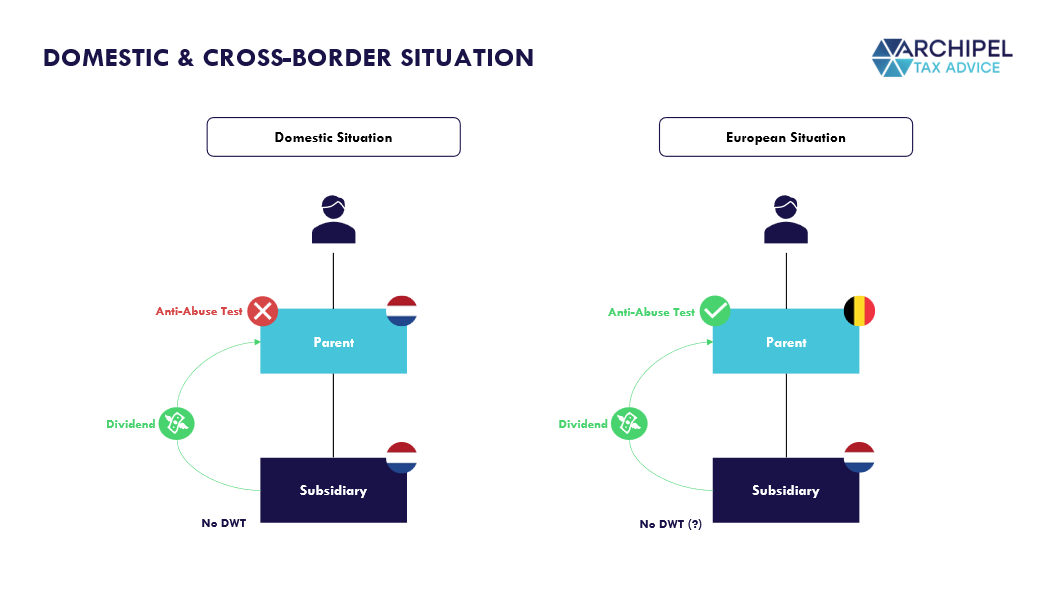
A crucial difference between the domestic situation and a cross-border situation is that, in the latter case, an anti-abuse test must also be applied.
In addition to the Directives (secondary EU law), we also have the fundamental freedoms in the EU – such as the freedom of establishment, the free movement of capital, and the free movement of persons (primary EU law).
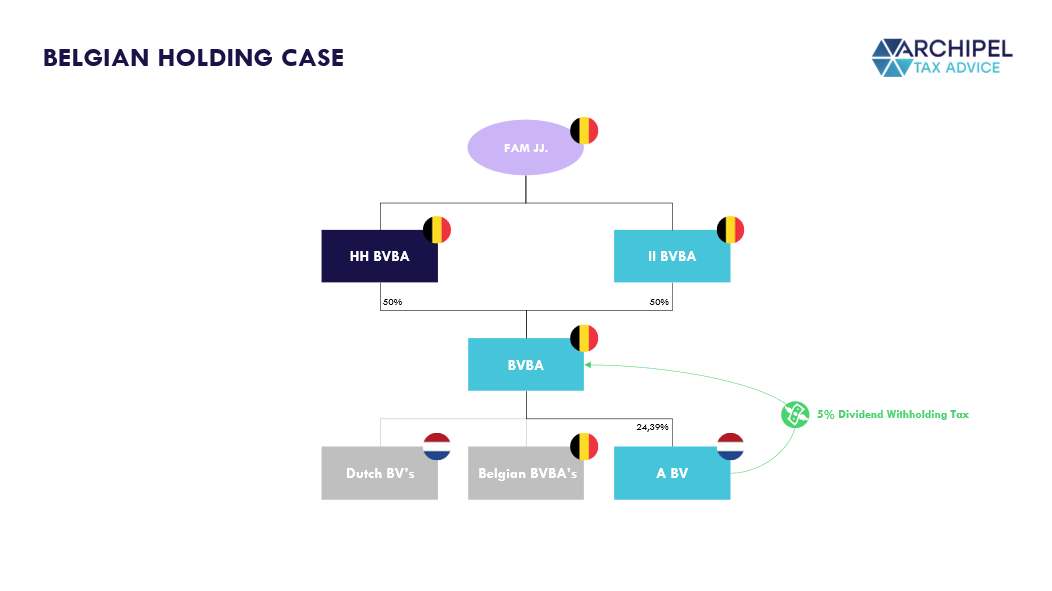
At first glance, you would expect the Belgian holding company in this picture is being discriminated because it is subjected to a more stringent test than a Dutch holding company. Such treatment is prohibited under the freedom of establishment. However – without going into all the technical nuances- this non-discrimination test cannot be applied if the Dutch anti-abuse test has been taken directly from the Parent-Subsidiary Directive and the Member State has (taken) no policy discretion of its own. The Supreme Court upholds the position taken earlier in the proceedings and therefore does not address the freedom of establishment.
The Dutch “Belgian Holding” Case
In the case before the Dutch Supreme Court, there is a Belgian family holding company investing in a Dutch group. The anti-abuse test provides that the withholding exemption does not apply if the shareholder holds the interest:
“… with the main purpose or one of the main purposes of avoiding taxation at another person, and where there is an artificial construction.”
To assess whether there is an artificial construction, the activities of the (direct or indirect) shareholder(s) of the distributing company must be examined. The Dutch substance requirements may be relevant here, but carrying on a genuine business enterprise may also be regarded as business-like. The parliamentary explanatory notes state the following (paraphrased):
“There are valid business reasons if these are reflected in the substance of the entity that directly holds the interest in the Dutch entity. This is the case, for example, if the entity that holds the interest carries on a material/genuine enterprise—that is, a lasting organization of capital and labor that participates in economic traffic with a profit motive—and the interest in the Dutch entity can be functionally attributed to its business assets.”
Back to the case: because, according to the Court, the direct shareholder has its own office space; the ultimate shareholder and his spouse perform many activities for the company; it has a significant cost structure; and it exerts a directing influence in a number of (Belgian) investments, it is considered to be carrying on a genuine enterprise. Consequently, there is no artificial structure, and the withholding exemption applies, according to th Court.The Amsterdam Court of Appeal nuanced this position and held that although there is a genuine enterprise, the shares may not be functionally attributed to the business assets due to a lack of active involvement. As a result, there is abuse according to the Amsterdam Court.
With that, the Court of Appeal adopts a line in which not the structure as a whole must be regarded as an artificial arrangement but instead focuses the analysis entirely on the shareholding in question. We find that a very narrow reading, because it would mean that companies cannot invest their surplus funds within the EU while making use of the Parent-Subsidiary Directive. For a more extensive discussion of the District Court and Court of Appeal judgments and an overview of the facts, see our previous article on this case:
The Dutch Supreme Court (Hoge Raad) Verdict
Since the District Court and the Court of Appeal reached different outcomes, there was hope that the Supreme Court would provide some clarifications. For example:
- May the Belgian holding company be subjected to a stricter test than a Dutch holding company – even though such a test may not be measured against the EU fundamental freedoms?
- Perhaps more a political question, but: should a holding company in the same country as its shareholders not, in any event, be regarded as a non-artificial structure?
- Does investing surplus funds in a shareholding between 5% and 50% without active involvement – within an otherwise active group – therefore always constitute abuse?
- Where is the boundary between insufficient and sufficient involvement to qualify for the withholding exemption?
- Can there be a wholly artificial arrangement while the District Court concluded that the Belgian holding carries on an (active) enterprise? Is the lack of involvement so weighty that it makes the investment artificial straightaway?
In this judgment, the Supreme Court is very restrained and decides that the Court of Appeal did not display an incorrect interpretation of the law, and that the Supreme Court is not empowered to re-assess the factual abuse analysis because it is not a court of fact. The latter is understandable, but it remained unfortunate that so much remained unclear.
Comparable Case at a European Level: The ECJ’s “Neo” Case
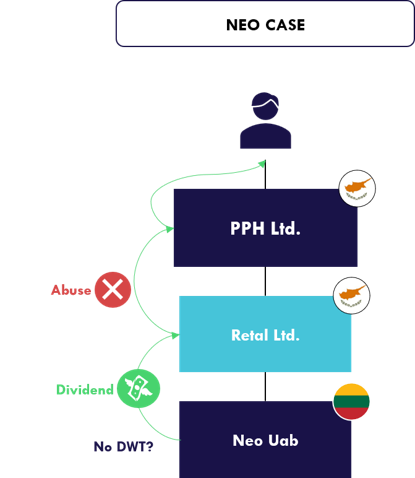
In the European NEO case, a Lithuanian company distributed a dividend to a Cypriot parent called Retal Ltd. Just like the Belgian Holding company, Retal Ltd. carried out a genuine economic activity. The position was therefore taken that the Lithuanian dividend withholding tax exemption applied.
However, above Retal Ltd. a series of transactions took place. PPH Ltd. was set-up just before the transaction. The shares in Retal Ltd. were transferred to PPH Ltd. in exchange for a receivable that was assigned to the UBO, also a tax resident of Cyprus.
The dividends were used to settle the loan with the UBO and as such, a tax benefit was achieved. The Lithuanian tax authorities took the position that this series of transactions, carried out outside Lithuania, was artificial and had been put in place to avoid Lithuanian withholding tax. The national court asked preliminary questions to the EU Court of Justice whether this refusal is compatible with the anti-abuse provision of the Parent-Subsidiary Directive.
No need to analyse in full detail whether this case should constitute abuse or not (even though the EU Court of Justice ruled in this direction), but what is most interest about this case for our Belgian Holding Case is that the EU Court of Justice ruled that the fact that Retal Ltd. carries out a genuine economic activity does not rule out abuse of the EU Parent Subsidiary directive.
(…) the fact that, in an arrangement involving more than one step, the first transaction consists of the distribution of dividends by a subsidiary to a parent company which carries on an actual economic activity does not, in itself, support the conclusion that there is no abusive practice. To analyse only the economic activity of that parent company, without taking into account the other relevant elements, would not be consistent with the necessity of carrying out an overall examination (…).
Take-Aways: Consider ‘Active Involvement’ and not just ‘Substance’
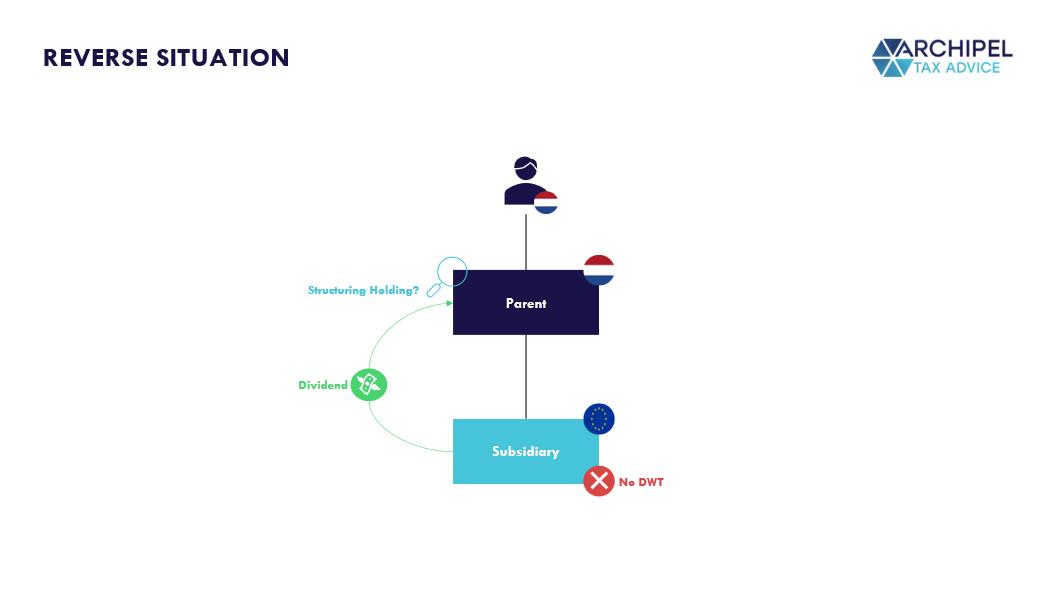
Now that we know that abuse can play a role in genuine economic structures and taking into account the Belgian Holding Case, the conclusion can be drawn that active involvement is crucial. It is therefore important to “equip” a holding company accordingly. This applies in any case to foreign holding companies that invest in the Netherlands (such as Belgian companies), but also to Dutch holding companies that invest in other EU Member States—the Parent-Subsidiary Directive, after all, works both ways.
We recommend in this situation to:
- Draw a salary from the holding company;
- Have office space available for the holding company;
- Undertake as many economic activities as possible with the holding company;
- Exercise as much active involvement as possible at the level of the subsidiary, e.g.:
- by shareholder resolutions;
- by involvement through management support.
If you would like to have a more detailed analysis of the involvement in your business structure, we are happy to help!